Passive vs Active Server Rack Cooling: Which Does Your Business Need?
Choosing the right cooling system is simpler than most people think once you understand the two fundamental approaches: passive and active cooling. This guide explains both, sets out the heat load thresholds that determine which you need, and helps you match the right Maxi-Cool system to your situation.
What is passive cooling?
Passive cooling uses filtered ventilation to cool a server rack. Integrated fans draw a continuous stream of ambient air in through filtered vents, across your server equipment, and out again — absorbing and dispersing heat in the process.
Because of this simplicity, passive cooling has some significant practical advantages:
- Minimal power consumption — among the most cost-effective server cooling options available
- No specialist installation — plug into a standard 13-amp wall socket and you’re running
- Quiet operation — under 65dB, suitable for open offices and customer-facing environments
- IP54 rated — protected against dust ingress and water splashing, keeping equipment clean and maintenance low
- No structural modifications — ideal for low heat server rack loads in listed buildings, serviced offices, and leasehold premises
Passive cooling works best in controlled environments with ambient room temperature. If ambient temperatures rise significantly or server loads exceed the ventilation system’s capacity, it’s time to consider active cooling — or plan ahead with a scalable system.
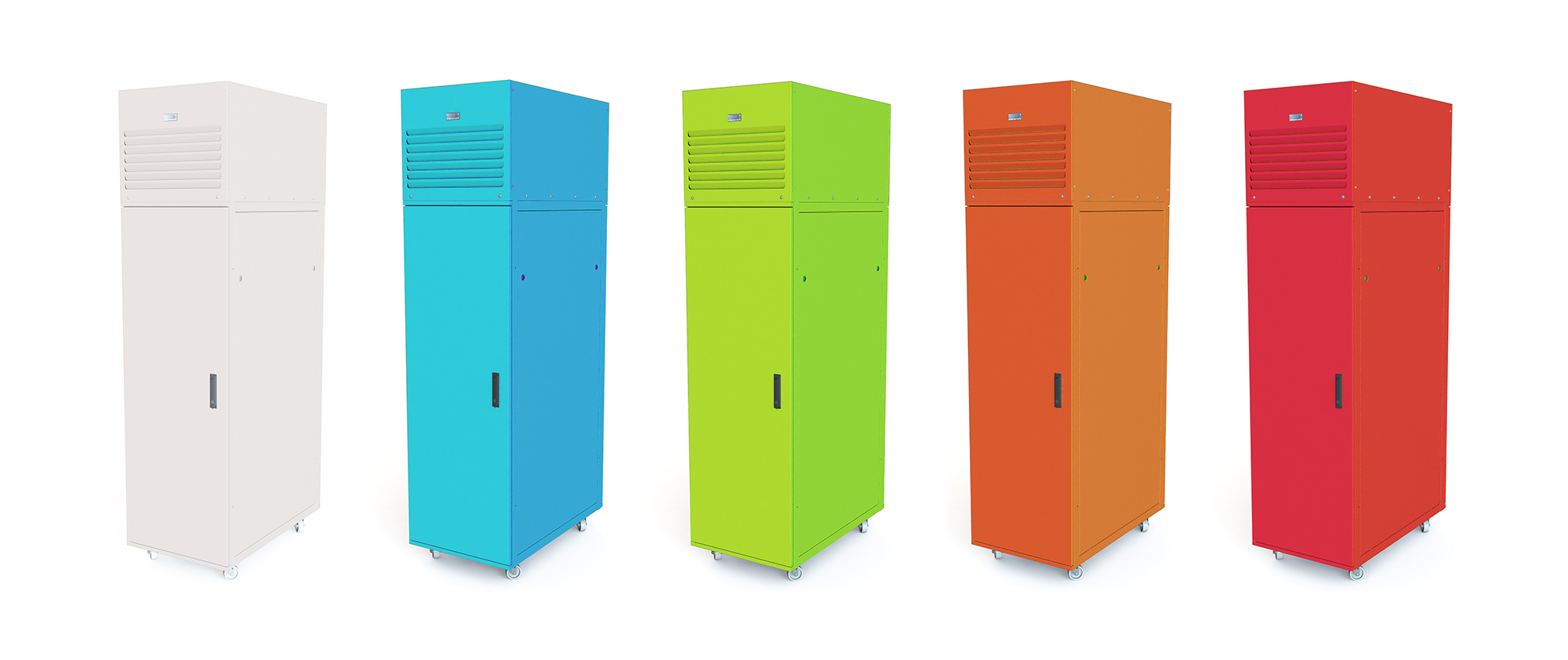
The Maxi-Cool Mercury is our passive cooling solution. Available from 18U upwards, mounted on castors for easy repositioning, and fully customisable in any RAL colour, the Mercury is for businesses that need reliable, clean cooling for lighter server heat loads. The Mercury cabinet is suitable for server rooms and can also be retrofitted with a Gemini cooling system if the heat load increases over time or the rack location changes.
What is active cooling?
Active cooling uses a refrigeration cycle — a compressor, evaporator, and condenser — to remove heat directly from the cabinet, regardless of the ambient room temperature. Rather than relying on cool incoming air, active systems generate their own cooling capacity and deliver it precisely to your server intakes.
This approach offers considerably more cooling power and operates independently of the surrounding room’s conditions. Key characteristics include:
- Up to 5kW (and above) of close-control cooling delivered directly into the rack
- Closed-loop operation — air is recirculated inside the cabinet, keeping dust, moisture, and contaminants out entirely
- Works in warm, dusty, or uncontrolled environments where passive cooling would struggle
- Eliminates hotspots — every item of equipment receives cooling air at precisely the right temperature
- More energy-efficient than cooling a whole room — only the cabinet is cooled, not the surrounding space
Maxi-Cool offers two active cooling systems, each suited to different situations.
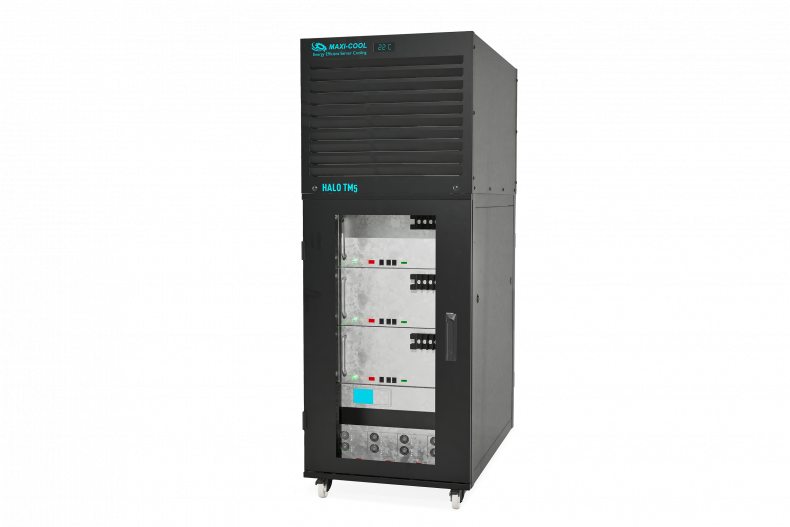
The Halo TM5 is a top-mounted, self-contained active cooling unit delivering 5kW of cooling power. It sits above the cabinet rather than occupying rack space, and requires no external condenser. The Halo expels waste heat as warm air from the top of the unit. It activates automatically when cabinet intake temperatures rise above 21°C and runs from a standard 13-amp plug, making installation, positioning, and repositioning very straightforward.
The Gemini is a split-system active cooler, also starting at 5kW and scalable above that. Unlike the Halo, the Gemini uses a remote condenser located separately from the cabinet, redirecting waste heat away from the immediate environment. The Gemini is particularly well-suited to higher heat loads, industrial or dusty environments, and situations where you need to move waste heat to a different part of the building. The Gemini is also available in a travel case version for fully portable deployments.
The heat load question: how to know which you need
Heat load — the amount of heat your servers generate, measured in kilowatts — is the primary factor in choosing between passive and active cooling. Here is a practical guide to the thresholds:
Under 1–2kW heat load. Light server loads, small office setups, edge computing nodes, and basic networking equipment typically fall into this range. If the room is air-conditioned or temperature-controlled, passive cooling with the Mercury is usually sufficient — and significantly more cost-effective to run.
2–5kW heat load. A medium-density server rack is often found in growing businesses and in offices without dedicated environmental cooling. The Maxi-Cool Halo is a suitable option as it is self-contained, does not require external works and is straightforward to install in any standard office environment.
5 kW and above, or challenging environments: High-density server loads, factory environments, dusty or industrial spaces, or poor ambient air quality call for the Gemini split system. Because the Gemini recirculates air in a fully closed loop and vents heat remotely via an external condenser, it performs reliably where other systems — including the Halo — would be less effective.
Beyond raw heat load, there are several environmental factors worth considering:
- Room temperature — if the ambient room gets warm in summer without air conditioning, passive cooling becomes less effective as the season progresses
- Air quality — dusty, industrial, or basement environments suit the Gemini’s closed-loop design, which keeps contaminants entirely out of the cabinet.
- Space constraints — the Halo mounts on top of the cabinet, preserving all usable rack space; important where U-space is at a premium
- Building restrictions — both passive and active Maxi-Cool systems require no structural modifications, no water feeds, and no external planning considerations, making them suitable for listed buildings, rented offices, and any space where traditional air conditioning installation is not possible.
Quick Decision Guide
| Your situation | Recommended Solution | |
| Light server load, controlled room temperature | Mercury (passive) | |
| Medium load, office environment, no external works required | Halo (active, top-mount) | |
| High load, dusty or warm environment, or a remote condenser is needed | Gemini (active split system) | |
| Starting small but expecting growth | Mercury now, Gemini retrofit later | |
| Listed building or rented office with no structural modification permitted | Any Maxi-Cool system | |
| Portable or temporary deployment needed | Gemini (travel case version) |
Not sure which system is right for you?
Every business is different — and every server environment has its own combination of heat load, room conditions, space constraints, and budget. The Maxi-Cool team works closely with each customer to find the right solution for their specific situation, and there is no one-size-fits-all answer.
If you are unsure whether your current setup needs passive or active cooling, or if you are planning a new installation and want to get it right from the start, we are happy to advise.
Call us: 01733 873262 Email: info@maxi-cool.co.uk